For those of you who do not know, James and I are now in Amman, Jordan. It was a very interesting trip to get here. A couple of weeks ago James and I found out about the Rebuild Iraq Expo in Amman, Jordan. So we decided that this would be a great place for us to go. Both of us really wanted to visit Amman to see the many places spoke of in the bible. Lori decided to stay behind as she is now working for the University of Dohuk and they have a deadline for writing the college catalog. She didn’t really want to go to Jordan anyway. So we left here with as much money as we could and headed off for Erbil International Airport.

I am not sure what it is about Erbil, but it seems that every time we go there something does not work out. Our interpreter had his relative drive us to Erbil and dropped us off at the USAID compound in Ankara where James and I had a meeting. After our meeting we took a taxi to the Airport. We got to the airport early and made sure everything was ok. We did not have a lot of money so we decided to talk to the bank and see if my transfer had gone through yet. It had not so we sat down to wait for the plane to leave. We knew that we had enough money to make it to Amman and we figured that we would just arrange a transfer once we got there. Our flight was supposed to leave at 5pm. Around 6pm the man in charge of the flight came in to tell us that our flight had been cancelled and we were supposed to go out and get our ticket, reclaim our checked luggage, go find a hotel, and come back tomorrow. As James and I did not have money to do any of this we started to worry. Earlier we had talked to the Western Union people about transferring money and found out that you can not do a credit card transfer online from Iraq for Iraq. We finally got in touch with Dr. Paul Kingery and he took care of sending us some money. This money was enough to take a taxi to the hotel, pay for the hotel, and take a taxi back from the airport. So we did this. The next day we got to the airport at 11:30 AM. James had been told that the flight to Amman would take off at 1PM so we did out best to be there on time. When we arrived at the airport the informed us that the flight did not leave until 5PM and that we could start checking in at 3PM. So we knew we would have to wait for a few hours. Again James and I tried to use Western Union to send us some money, but again they would not let us. So I called my bank to find out why. My bank told me that they could send a Western Union transfer directly from my bank account and it would not cost as much as having Western Union do it. So I told them to transfer the money. Sure enough slick as can be they transferred the money and James and I were sitting pretty. I love gaining new knowledge; I just wish it did not always have to be so hard.
After our financial problems were solved we got on out flight and flew to Jordan. The flight was not too bad, but the seats are not assigned and James and I ended up sitting in the middle of the plane right behind the exit seats. In the exit rows were six people who were so short that there heads did not even come up above the seat. James and I were wondering why they needed the extra leg-room. So we sat behind them. It was not long until the man sitting in the exit row decided to put his chair back in my lap. The flight attendant saw that and quickly came to my rescue and told the man to put his chair up. We landed 2 hours later after criss-crossing our way across the sky. I am not sure but I think we made lazy S’s the entire way from Erbil to Amman. Good thing I don’t get motion sickness.
James and I landed in Amman and boarded a bus. It seemed that the people were in a much bigger hurry then we were as the shouldered their way to the front of the lines and were generally rude. So James and I let them past and walked slowly through the line. When we got up to passport control we had a person take our passports and run us through the visa, passport control, baggage claim, and arranged for us to get a cell-phone and a ride to our hotel. We were in our car getting ready to leave before the first person that pushed and shoved their way in front of us were at baggage check. Interesting how earnest people seldom are really that intelligent. The reason we made it through that fast is everyone lined up in the first three passport checkpoints. We went to the fourth one which was completely empty. Even after we went through nobody went to those lines. I asked if there was a difference between the lines, and the man said there was not and that this problem always happened.
So after making it through the lines and out to a cab we were taken to our hotel. The cab driver was a very nice man who did his best to let us know what to look out for in Amman. He took us to the Samirammis Hotel and even negotiated a better deal for our room with the hotel clerk. Normally the rooms are 95 JD per night and he negotiated a deal for us to only pay 50 JD per night. As that was cheaper then any other hotel in town I was pleased. The only complaints I had about the hotel was there was not a hot tub, and there was no internet service inside the rooms. As there were two beds and a bathroom it was good enough for me and across the street was an internet café that allowed us to use our laptops. Everything we needed was taken care of.
Our first day here I went down to work on the internet. I wanted to check and see what was going on at the Expo that day. So I brought up the Expo website and could not believe what I saw. Our plane was a day late, so I was saddened that we would be a day late for the expo. It turned out that I was two months early. The expo was not March 7th to the 10th; it was May 7th to the 10th. I would have been mad at myself if we had not arranged for other things to do while we were here. This was not completely comforting as I did still feel like a moron. So we made the most of it. I quickly called a contact I had here in Amman and asked him if he would be willing to show us the sites in Jordan. He seemed very happy to have the opportunity to work with us.

The young man who we hired as a guide was a Jordanian names Bashar. He picked us up on Thursday around 7PM, as he worked until 6:30PM, and took us to downtown Amman. We sat in a hookah shop and talked to each other learning more about each other. We then made arrangements for him to pick us up at 8AM on Friday so he could show us around Jordan. James and I made an early night of it and woke up bright eyed and bushy tailed at 7AM that next morning.
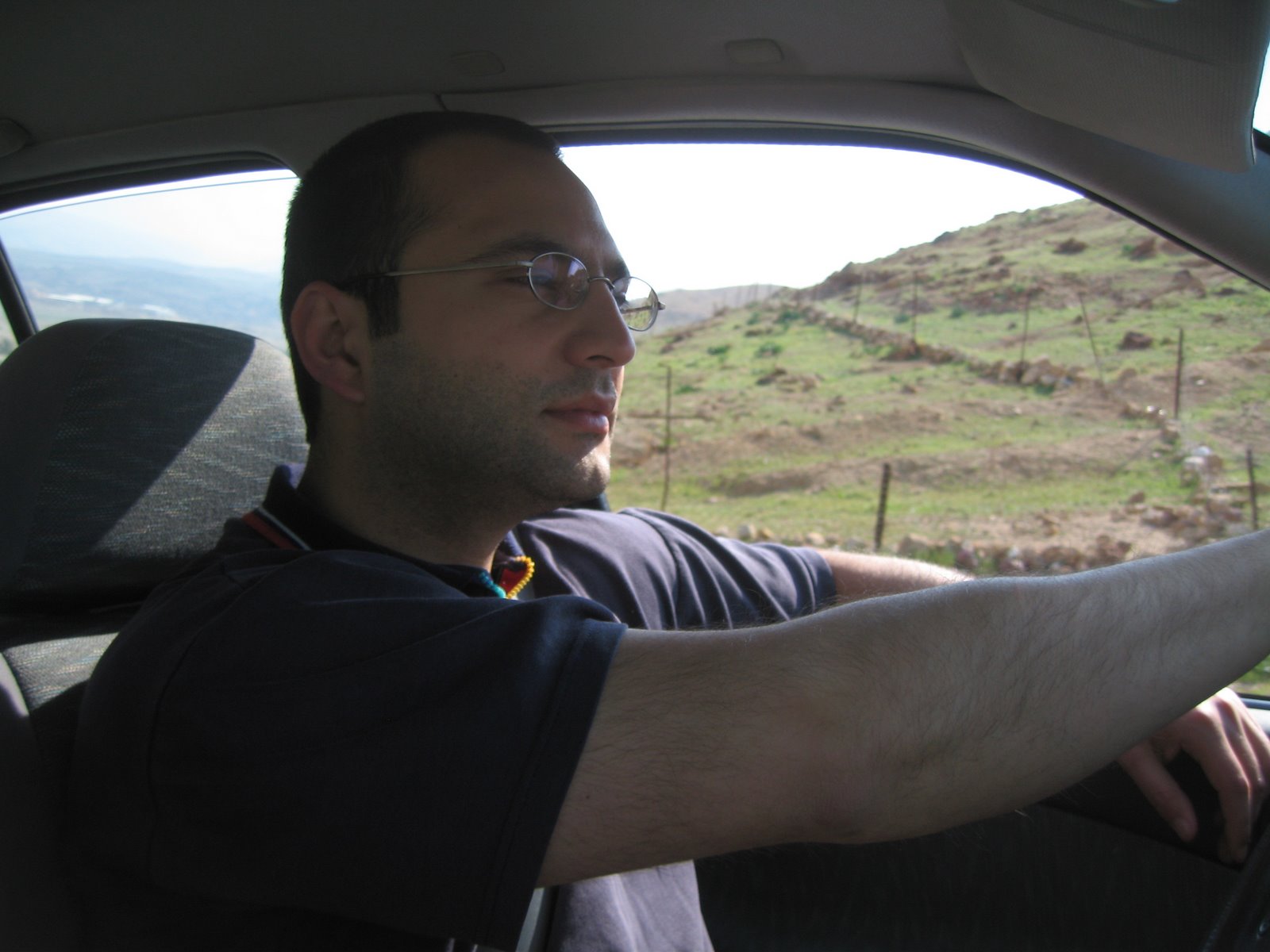
Bashar was waiting for us downstairs at 7:45AM I am impressed with people who are early. We got into his car and he drove us through the Jordanian countryside. If you have never been to Jordan or Israel then it is hard to imagine what this land looks like. The mountains are all old so they have a rolling slope to them. It almost looks like you are out on the ocean with large rolling waves all around you. The white rocks that break through the green grass looks like white flecks upon the oceans surface. Rolling hills give way to deep ravines. The houses are all on the hills, carved from the white stones that give structure and color to all the buildings in Amman. Driving towards the Dead Sea you start to see more evidence of farms. The long narrow fields are covered with plastic pulled tight over bent poles that give the impression of long worms stretching across the landscape. Most of the farms are located in the valleys with homes and businesses still clinging to the sides of the mountains and hills. As you creep closer to the Dead Sea the land starts to flatten out and you can feel the changing pressure on your ears as you drop below sea-level. Our journey to the Dead Sea was cut short as we did a U-turn to start a climb back up the way we came. This time we climbed more to the south up Mount Nebo. This mountain was made famous as the death place of the prophet Moses. As we crested the mountain we stopped at a park. The Franciscan Monks had built a large monastery here in the 5th century. The monastery still stands but is now more of a tourist site then anything else. You walk in through the front gate and walk up a tiled walkway that has red clay tiles inlayed with white tiles forming a sort of arrow pointing down the path. When you come to the top the path opens up into a courtyard that is tiled with large stones set in place over a thousand years ago. The monastery rises in front of you, a yellow tint covers the once white rocks and years of dust, sun, and rain left their own painted handiwork. Walking around to the north of the monastery you see the hundreds of vineyards and olive orchards scattered across the mountain sides. On the western slope you can look down and see the Jordan River Valley, and off in the distance you can see the city of Jericho. The day that we were there a light haze covered most of the Dead Sea and the Jordan River. We could see across into Israel but the haze did not let us see to far. We could see how Moses chose this spot to watch as his people traveled into the Promised Land.


After reflecting in this place for a while we walked back down to our car. Bashar then took us for a ride through the country side. Returning to Amman we went to a coffee shop that catered to university students and ExPats. There we met with Bashar’s friend Nancy. She was a local Jordanian who worked in the telecommunications industry. James had a lot of fun talking to her. Bashar had excused himself for a while so he could write his lesson for that evening. When he came back we left and James and I asked him to drop us off at a McDonalds and then we would find our way home from there. He agreed and told us he would see us again on Saturday at around 1:30 PM. He wanted to take us to the city of Jaresh. We agreed and left him to go and eat our McDonalds.


That next day Bashar was early as usual and we headed off for Jaresh. Bashar told us that this place was very famous but we had never heard of it. Once we got there we could see why it was famous. The sign said that Jaresh is the largest single site for Roman ruins in the world. The ruins stretched for over a mile in one direction. We spent the next two hours walking through temples, theaters, burial sites, archways, columned walkways, racetracks, and all manner of ruins. Some of the columns had fallen and were strewn about the site, but still others were very prominent in standing against the sky. Walking into the ruins you could see the variation in craftsmanship from the Greeks to the Romans. Walking the path we went to the temple of Artimis where Bashar showed us something very interesting. If you took a coin and balanced it on the column you could see an indication of the columns swaying. Without the wood holding the roof together the columns would sway. Interesting phenomenon if you ask me.


Leaving the ruins we got in the car and drove around the countryside. Bashar wanted us to see how the real people lived. We went through Palestinian refugee camps, which were just small cities that looked exactly like Dohuk and Erbil, and Bedouin and Gypsy camps that were just large tent cities. The people were all smiles with the exception of one sassy girl that ran out into traffic and then sassed back when Bashar honked his horn at her. Bashar then brought us to a local style restaurant where he fed us the traditional Jordanian fare. On our table we had flat bread that was made by slapping the dough unto a paddle and placing it in a brick oven to cook like a pizza crust. There was a dish of chopped tomatoes and cucumber that was tossed with vinegar and salt; a second dish was made of finely chopped parsley, basil, mint, and mixed with yogurt; a dish of hummus and olive oil was brought with a second dish of seasoned hummus; and a final appetizer of olives and pickled beets. After we ate our fill of this they brought us a plate of Kabobs serving chicken, ground meet, and steak pieces. We ate all of this food and washed it down with fresh squeezed lemon-aid.
Finishing our meal Bashar took us to our hotel. James and I wanted to eat at an Italian restaurant before we went back to Iraq so we had Bashar take us to one. If I might make a suggestion, don’t try out a restaurant for the first time when you are already full. The food was ok, but not great. After we left the restaurant we hailed a cab. We had been warned about how cab drivers might try to take advantage of you by not running their meters. We were wondering if this was true because every cab driver we had was very respectful and drove us exactly where we needed to go. After leaving the restaurant we got to meet with one of the other kind. We got into the cab and I asked out driver to turn on his meter. He told me that this was not a metered cab. So I asked him how much it would cost to go to Samirammis Hotel. He told me it would cost to JD. As I knew how far away from my hotel we were, and I also knew how to get back I knew that this ride should only cost about 1.5 JD. So I told him that I would pay him 2 JD but no more. He said that was not enough so I told him to pull over and we would get a different cab. So he pulled over and then asked us how much we would pay. I told him I would only pay 2 JD and he reluctantly agreed. On the way to the hotel he kept asking if we wanted to go to a night club, massage parlor, bar with Russian girls, or a bar with Arabic girls. We assured him that the only thing we wanted to do was go to our hotel and go to sleep. At this point he started to sulk like a little child. He did not speak to us until we go to our hotel. When we were there we paid him the 2 JD, thanked him, and left the cab. Why do people try to take advantage of tourists?
On Sunday James decided that he wanted to take the entire day to prepare for the GMAT that he was going to take on Monday. I was not sure what I was going to do. So I took a walk around the area in Amman that I was. I walked around just getting a taste of the people and the life in Amman. It is amazing to me what a difference it is just walking one street away. On Monday when James went to take his GMAT I transferred us to the Holiday Inn. The hotel we were staying in was ok, but I wanted to at least spend one night in a five star hotel. I thought I was being extravagant but with my creative online sleuthing I ended paying a very good rate. As I am a member of the club now I can continue to get good rates. So I think from now on we will be spending our time in Amman at the Holiday Inn.
Going to the airport from the Holiday Inn we took a Taxi. Again the Taxi tried to rip us off. In Jordan they have an interesting way of working the taxis. The number system has three decimal points. So one JD would be written 1.000 or even sometime written as 1,00. The cab ride from our hotel to the airport was 7390 or 7.39 JD’s. Our driver tried to tell us that it was over 73 JD. I gave him 10 JD and told him to hit the road before I called the police over. He quickly hit the bricks. Again, Why do they try to cheat us Americans?
I thought our flight was going to be cancelled again but it was just delayed one and a half hours. We still took off that night and made it back to Iraq safe. All in all it was a great journey.
I am not sure what it is about Erbil, but it seems that every time we go there something does not work out. Our interpreter had his relative drive us to Erbil and dropped us off at the USAID compound in Ankara where James and I had a meeting. After our meeting we took a taxi to the Airport. We got to the airport early and made sure everything was ok. We did not have a lot of money so we decided to talk to the bank and see if my transfer had gone through yet. It had not so we sat down to wait for the plane to leave. We knew that we had enough money to make it to Amman and we figured that we would just arrange a transfer once we got there. Our flight was supposed to leave at 5pm. Around 6pm the man in charge of the flight came in to tell us that our flight had been cancelled and we were supposed to go out and get our ticket, reclaim our checked luggage, go find a hotel, and come back tomorrow. As James and I did not have money to do any of this we started to worry. Earlier we had talked to the Western Union people about transferring money and found out that you can not do a credit card transfer online from Iraq for Iraq. We finally got in touch with Dr. Paul Kingery and he took care of sending us some money. This money was enough to take a taxi to the hotel, pay for the hotel, and take a taxi back from the airport. So we did this. The next day we got to the airport at 11:30 AM. James had been told that the flight to Amman would take off at 1PM so we did out best to be there on time. When we arrived at the airport the informed us that the flight did not leave until 5PM and that we could start checking in at 3PM. So we knew we would have to wait for a few hours. Again James and I tried to use Western Union to send us some money, but again they would not let us. So I called my bank to find out why. My bank told me that they could send a Western Union transfer directly from my bank account and it would not cost as much as having Western Union do it. So I told them to transfer the money. Sure enough slick as can be they transferred the money and James and I were sitting pretty. I love gaining new knowledge; I just wish it did not always have to be so hard.
After our financial problems were solved we got on out flight and flew to Jordan. The flight was not too bad, but the seats are not assigned and James and I ended up sitting in the middle of the plane right behind the exit seats. In the exit rows were six people who were so short that there heads did not even come up above the seat. James and I were wondering why they needed the extra leg-room. So we sat behind them. It was not long until the man sitting in the exit row decided to put his chair back in my lap. The flight attendant saw that and quickly came to my rescue and told the man to put his chair up. We landed 2 hours later after criss-crossing our way across the sky. I am not sure but I think we made lazy S’s the entire way from Erbil to Amman. Good thing I don’t get motion sickness.
James and I landed in Amman and boarded a bus. It seemed that the people were in a much bigger hurry then we were as the shouldered their way to the front of the lines and were generally rude. So James and I let them past and walked slowly through the line. When we got up to passport control we had a person take our passports and run us through the visa, passport control, baggage claim, and arranged for us to get a cell-phone and a ride to our hotel. We were in our car getting ready to leave before the first person that pushed and shoved their way in front of us were at baggage check. Interesting how earnest people seldom are really that intelligent. The reason we made it through that fast is everyone lined up in the first three passport checkpoints. We went to the fourth one which was completely empty. Even after we went through nobody went to those lines. I asked if there was a difference between the lines, and the man said there was not and that this problem always happened.
So after making it through the lines and out to a cab we were taken to our hotel. The cab driver was a very nice man who did his best to let us know what to look out for in Amman. He took us to the Samirammis Hotel and even negotiated a better deal for our room with the hotel clerk. Normally the rooms are 95 JD per night and he negotiated a deal for us to only pay 50 JD per night. As that was cheaper then any other hotel in town I was pleased. The only complaints I had about the hotel was there was not a hot tub, and there was no internet service inside the rooms. As there were two beds and a bathroom it was good enough for me and across the street was an internet café that allowed us to use our laptops. Everything we needed was taken care of.
Our first day here I went down to work on the internet. I wanted to check and see what was going on at the Expo that day. So I brought up the Expo website and could not believe what I saw. Our plane was a day late, so I was saddened that we would be a day late for the expo. It turned out that I was two months early. The expo was not March 7th to the 10th; it was May 7th to the 10th. I would have been mad at myself if we had not arranged for other things to do while we were here. This was not completely comforting as I did still feel like a moron. So we made the most of it. I quickly called a contact I had here in Amman and asked him if he would be willing to show us the sites in Jordan. He seemed very happy to have the opportunity to work with us.
The young man who we hired as a guide was a Jordanian names Bashar. He picked us up on Thursday around 7PM, as he worked until 6:30PM, and took us to downtown Amman. We sat in a hookah shop and talked to each other learning more about each other. We then made arrangements for him to pick us up at 8AM on Friday so he could show us around Jordan. James and I made an early night of it and woke up bright eyed and bushy tailed at 7AM that next morning.
Bashar was waiting for us downstairs at 7:45AM I am impressed with people who are early. We got into his car and he drove us through the Jordanian countryside. If you have never been to Jordan or Israel then it is hard to imagine what this land looks like. The mountains are all old so they have a rolling slope to them. It almost looks like you are out on the ocean with large rolling waves all around you. The white rocks that break through the green grass looks like white flecks upon the oceans surface. Rolling hills give way to deep ravines. The houses are all on the hills, carved from the white stones that give structure and color to all the buildings in Amman. Driving towards the Dead Sea you start to see more evidence of farms. The long narrow fields are covered with plastic pulled tight over bent poles that give the impression of long worms stretching across the landscape. Most of the farms are located in the valleys with homes and businesses still clinging to the sides of the mountains and hills. As you creep closer to the Dead Sea the land starts to flatten out and you can feel the changing pressure on your ears as you drop below sea-level. Our journey to the Dead Sea was cut short as we did a U-turn to start a climb back up the way we came. This time we climbed more to the south up Mount Nebo. This mountain was made famous as the death place of the prophet Moses. As we crested the mountain we stopped at a park. The Franciscan Monks had built a large monastery here in the 5th century. The monastery still stands but is now more of a tourist site then anything else. You walk in through the front gate and walk up a tiled walkway that has red clay tiles inlayed with white tiles forming a sort of arrow pointing down the path. When you come to the top the path opens up into a courtyard that is tiled with large stones set in place over a thousand years ago. The monastery rises in front of you, a yellow tint covers the once white rocks and years of dust, sun, and rain left their own painted handiwork. Walking around to the north of the monastery you see the hundreds of vineyards and olive orchards scattered across the mountain sides. On the western slope you can look down and see the Jordan River Valley, and off in the distance you can see the city of Jericho. The day that we were there a light haze covered most of the Dead Sea and the Jordan River. We could see across into Israel but the haze did not let us see to far. We could see how Moses chose this spot to watch as his people traveled into the Promised Land.
After reflecting in this place for a while we walked back down to our car. Bashar then took us for a ride through the country side. Returning to Amman we went to a coffee shop that catered to university students and ExPats. There we met with Bashar’s friend Nancy. She was a local Jordanian who worked in the telecommunications industry. James had a lot of fun talking to her. Bashar had excused himself for a while so he could write his lesson for that evening. When he came back we left and James and I asked him to drop us off at a McDonalds and then we would find our way home from there. He agreed and told us he would see us again on Saturday at around 1:30 PM. He wanted to take us to the city of Jaresh. We agreed and left him to go and eat our McDonalds.
That next day Bashar was early as usual and we headed off for Jaresh. Bashar told us that this place was very famous but we had never heard of it. Once we got there we could see why it was famous. The sign said that Jaresh is the largest single site for Roman ruins in the world. The ruins stretched for over a mile in one direction. We spent the next two hours walking through temples, theaters, burial sites, archways, columned walkways, racetracks, and all manner of ruins. Some of the columns had fallen and were strewn about the site, but still others were very prominent in standing against the sky. Walking into the ruins you could see the variation in craftsmanship from the Greeks to the Romans. Walking the path we went to the temple of Artimis where Bashar showed us something very interesting. If you took a coin and balanced it on the column you could see an indication of the columns swaying. Without the wood holding the roof together the columns would sway. Interesting phenomenon if you ask me.
Leaving the ruins we got in the car and drove around the countryside. Bashar wanted us to see how the real people lived. We went through Palestinian refugee camps, which were just small cities that looked exactly like Dohuk and Erbil, and Bedouin and Gypsy camps that were just large tent cities. The people were all smiles with the exception of one sassy girl that ran out into traffic and then sassed back when Bashar honked his horn at her. Bashar then brought us to a local style restaurant where he fed us the traditional Jordanian fare. On our table we had flat bread that was made by slapping the dough unto a paddle and placing it in a brick oven to cook like a pizza crust. There was a dish of chopped tomatoes and cucumber that was tossed with vinegar and salt; a second dish was made of finely chopped parsley, basil, mint, and mixed with yogurt; a dish of hummus and olive oil was brought with a second dish of seasoned hummus; and a final appetizer of olives and pickled beets. After we ate our fill of this they brought us a plate of Kabobs serving chicken, ground meet, and steak pieces. We ate all of this food and washed it down with fresh squeezed lemon-aid.
Finishing our meal Bashar took us to our hotel. James and I wanted to eat at an Italian restaurant before we went back to Iraq so we had Bashar take us to one. If I might make a suggestion, don’t try out a restaurant for the first time when you are already full. The food was ok, but not great. After we left the restaurant we hailed a cab. We had been warned about how cab drivers might try to take advantage of you by not running their meters. We were wondering if this was true because every cab driver we had was very respectful and drove us exactly where we needed to go. After leaving the restaurant we got to meet with one of the other kind. We got into the cab and I asked out driver to turn on his meter. He told me that this was not a metered cab. So I asked him how much it would cost to go to Samirammis Hotel. He told me it would cost to JD. As I knew how far away from my hotel we were, and I also knew how to get back I knew that this ride should only cost about 1.5 JD. So I told him that I would pay him 2 JD but no more. He said that was not enough so I told him to pull over and we would get a different cab. So he pulled over and then asked us how much we would pay. I told him I would only pay 2 JD and he reluctantly agreed. On the way to the hotel he kept asking if we wanted to go to a night club, massage parlor, bar with Russian girls, or a bar with Arabic girls. We assured him that the only thing we wanted to do was go to our hotel and go to sleep. At this point he started to sulk like a little child. He did not speak to us until we go to our hotel. When we were there we paid him the 2 JD, thanked him, and left the cab. Why do people try to take advantage of tourists?
On Sunday James decided that he wanted to take the entire day to prepare for the GMAT that he was going to take on Monday. I was not sure what I was going to do. So I took a walk around the area in Amman that I was. I walked around just getting a taste of the people and the life in Amman. It is amazing to me what a difference it is just walking one street away. On Monday when James went to take his GMAT I transferred us to the Holiday Inn. The hotel we were staying in was ok, but I wanted to at least spend one night in a five star hotel. I thought I was being extravagant but with my creative online sleuthing I ended paying a very good rate. As I am a member of the club now I can continue to get good rates. So I think from now on we will be spending our time in Amman at the Holiday Inn.
Going to the airport from the Holiday Inn we took a Taxi. Again the Taxi tried to rip us off. In Jordan they have an interesting way of working the taxis. The number system has three decimal points. So one JD would be written 1.000 or even sometime written as 1,00. The cab ride from our hotel to the airport was 7390 or 7.39 JD’s. Our driver tried to tell us that it was over 73 JD. I gave him 10 JD and told him to hit the road before I called the police over. He quickly hit the bricks. Again, Why do they try to cheat us Americans?
I thought our flight was going to be cancelled again but it was just delayed one and a half hours. We still took off that night and made it back to Iraq safe. All in all it was a great journey.

